Education & Outreach
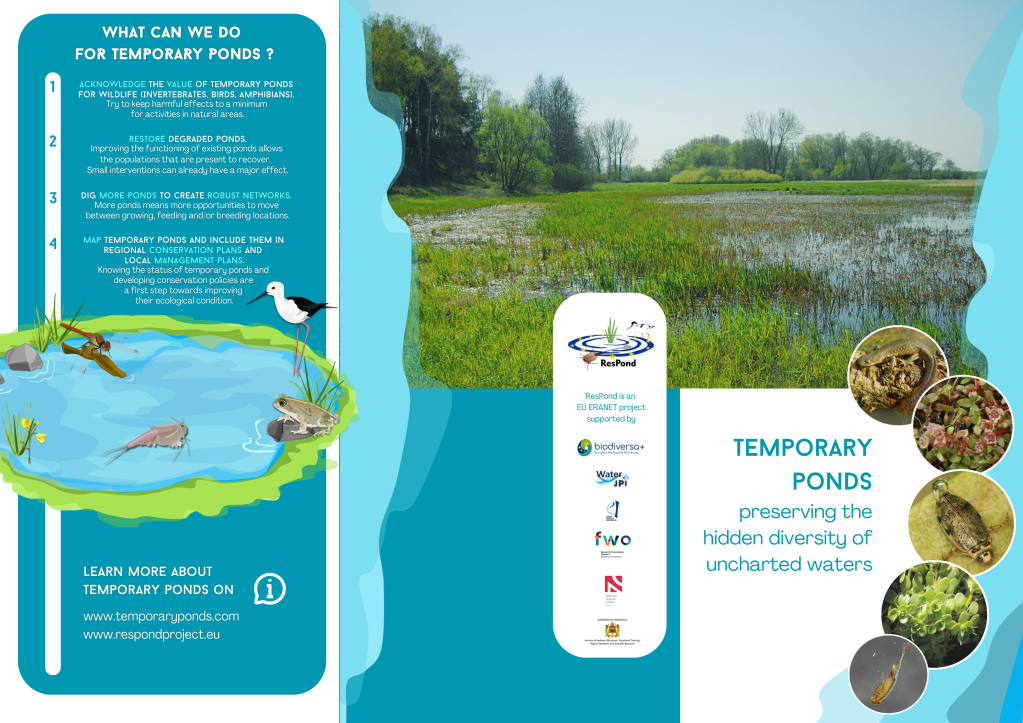
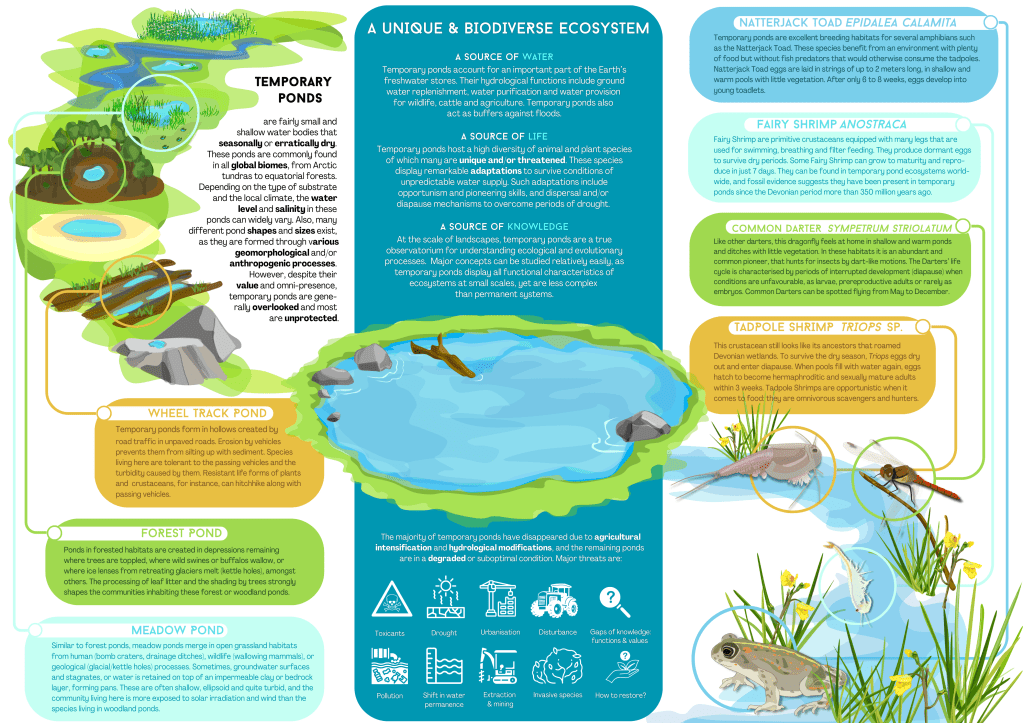
If you want to learn more about temporary ponds and spread this knowledge, have a look at our brochure. Feel free to download it and print it in case you want to distribute it. We deliberately made it general so it can be informative for any stakeholder in different parts of the EU and beyond. It may be distributed in a visitor’s center of a Nature Reserve. It can also be an appetiser you may use as part of a temporary pond project in schools. A more region specific brochure was made in French and Arabic for Morocco.
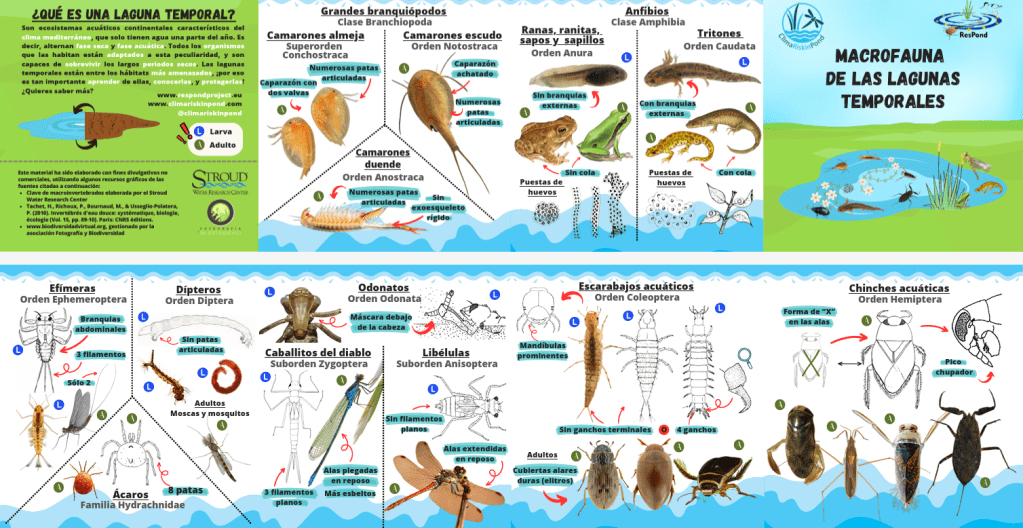
We also made a general brochure that can help to identify major groups of organisms from temporary ponds which can be downloaded here.
Below we provide an activity that could be part of a school project on temporary ponds.
- Uncovering the hidden biodiversity of temporary ponds – an experimental protocol to rear species from temporary pond sediment
Much of the biodiversity of temporary ponds is present in de sediment in the form of dormant life stages. Look for a depression in your region where you know a pond exists during some part of the year. This can be a small system such as a roadside pool or a shallow pond in a meadow. Ideally it keeps water for a few months. When the pond is dry, you can collect some sediment. Use a spoon or a small shovel to collect the top 1-2cm of sediment. This is where most of the dormant life stages will be present. If you put the aquarium behind a window in the sun, the light and the nutrients in the sediment may be enough for microorganisms and algae to develop which, in turn, will feed any larger animals that may hatch from the sediment.
If the sediment is still moist it is best to let it dry to the air. When the sediment has dried for a few weeks you put the dry sediment in an aquarium and add water. Make sure that you add very little sediment. In a 10L aquarium 150g of sediment may be more than enough. In as small 3 or 5L aquarium a handful of sediment may be sufficient. Add rainwater or distilled water, NOT tap water. Many resting eggs respond to the trigger of water with little or no dissolved salts by hatching. If you add tap water this may not happen or to a much lesser extent. It can also be helpful to put the water in a refrigerator before adding it. This mimics typical conditions that occur in the field when temporary ponds fill. You don’t need to add an aquarium filter because this filter will remove the phytoplankton that is needed as a food source. It can be a good idea to add a small airpump to bubble some air. This can keep the oxygen concentration up and prevents the formation of a biofilm on the water.
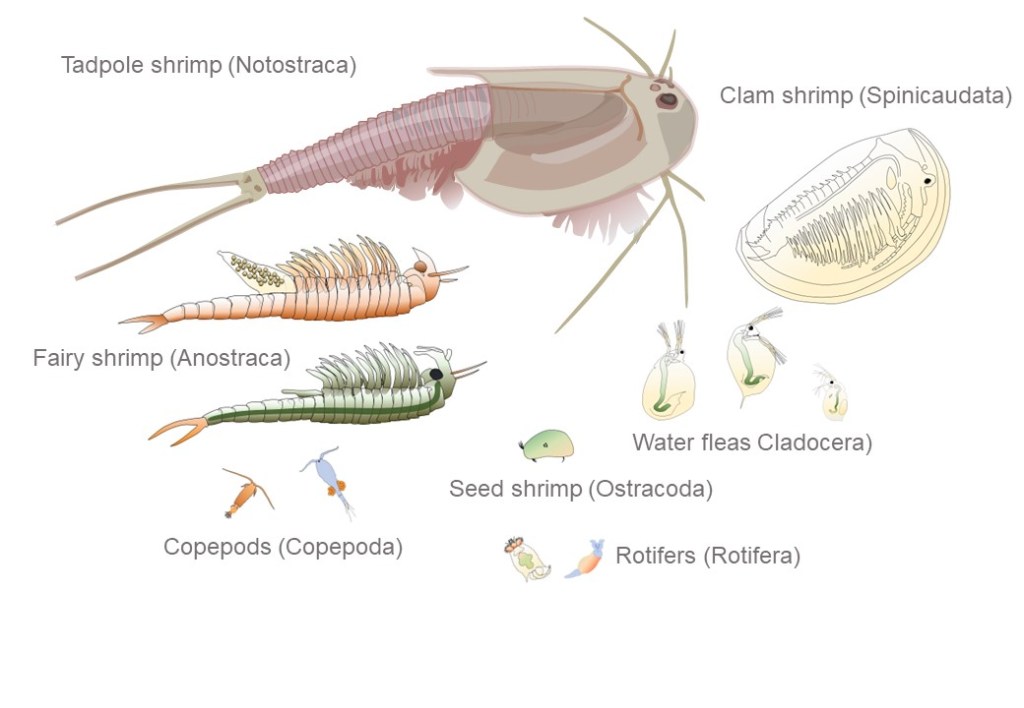
You may already see crustaceans swimming around in less than a week’s time. Check the figure above to see if you can recognise some of them. If you are lucky you will find large branchiopod crustaceans like fairy shrimp, clam shrimp or tadpoleshrimp which can reach several centimeters in length. They used to occur worldwide in temporary ponds but have become exceedingly rare in many places. If you find them it would be important for you to upload the observation to a citizen science platform like www.observation.org. This way scientists know where you found it. Tadpole shrimp are carnivores and will first start to eat other organisms in the aquarium before they start to munch on conspecifics. To keep them happy you can add some small pellets used to feed aquarium fish (e.g. Tetra micro pellets) which they may consume. But watch out, the high protein content of these pellets can lead to the formation of nitrite in the water which may kill your animals. If you add food it may be good to replace half of the water on a weekly basis to prevent accumulation of nutrients and build up of nitrite. Fairy shrimp and other filter feeders do not require any food to be added and can be sustained based on the photosynthesis of algae and production of other microorganisms in this micro-ecosystem. There are usually plenty of nutrients present in the sediment you added initially to keep this system going. Keeping them at high densities, however, will require a culture of phytoplanktonic algae as a food source. The species that hatched from dormant eggs will start to produce dormant eggs themselves. Some species can do this as early as 7 days after they themselves hatched, others will need a few weeks. You will notice that after some weeks or months your organisms will start to die but this is normal! The new eggs they hopefully produced are now waiting in the sediment but will require another dry period before they are ready to hatch a new generation.
 Temporary Ponds