
More information
Below we list some foundational books, papers and researchers that are worth checking out if you are interested in temporary ponds.
Useful books
The Biology of Temporary Waters is a book by D. Dudley Williams that provides a great general overview and is a must read. We are also a fan of his older book, The Ecology of Temporary Waters
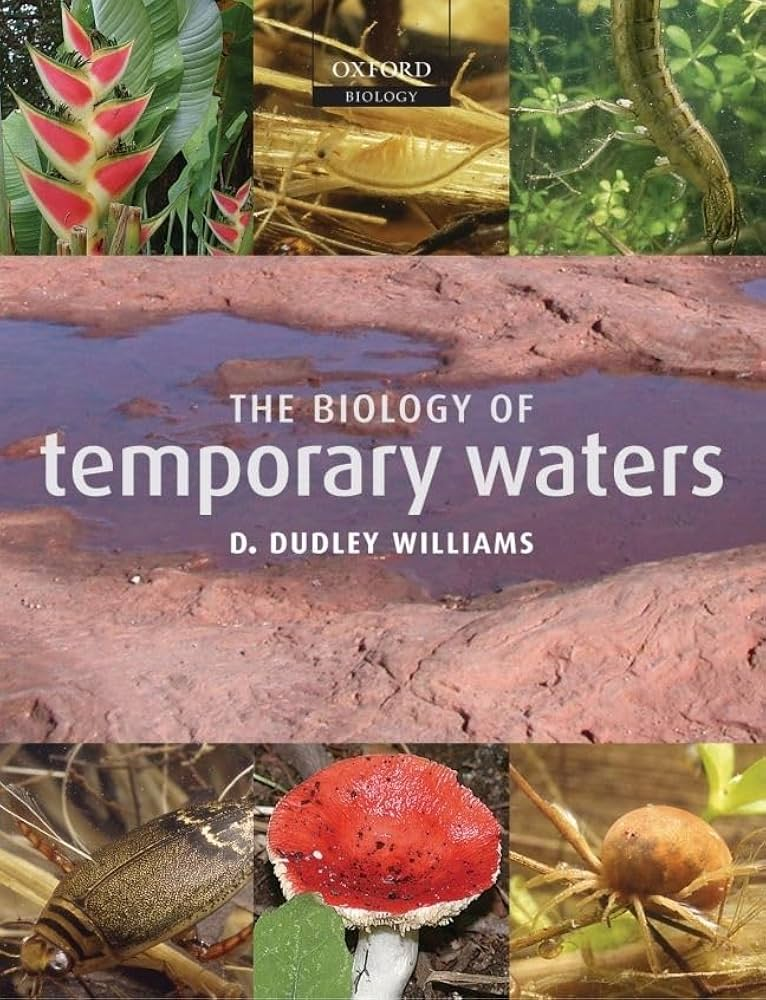
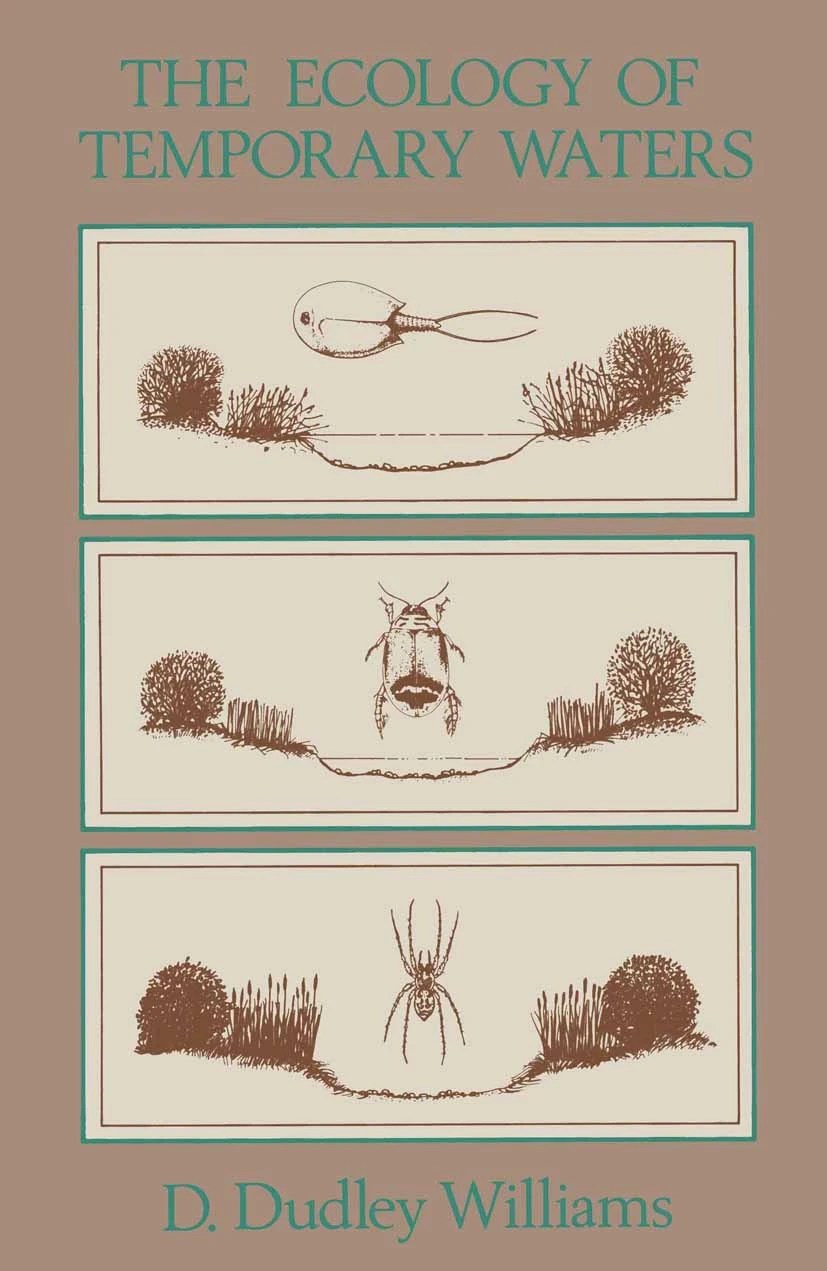
Below I list some basic papers we give to students, who want to learn more about temporary ponds :
Basic papers on temporary pond ecology
Wellborn, G. A., Skelly, D. K., & Werner, E. E. (1996). Mechanisms creating community structure across a freshwater habitat gradient. Annual Review of Ecology, Evolution, and Systematics, 27, 337–363. https://doi.org/10.1146/annurev.ecolsys.27.1.337
The paper provides a clear synthesis of what makes a temporary pond different from a permanent one focusing on the role of drought and fish in shaping communities.
Schneider, D. W., & Frost, T. M. (1996). Habitat duration and community structure in temporary ponds. Journal of the North American Benthological Society, 15(1), 64–86. https://doi.org/10.2307/1467433
Here conceptual models and field data are used to show what happens when ponds hold water longer (i.e. have a longer hydroperiod). For instance, they can be more diverse because they allow more species to complete their life cycles.
If you ever want to know what the effect is of pond hydrology on temporary pond biota, it is important to consider that many hydrological variables are correlated. Yet simple models can help to reconstruct the long term hydroregime of temporary ponds, which can explain a large fraction of variation in communities.
Vanschoenwinkel, B., Hulsman, A., De Roeck, E., De Vries, C., Seaman, M., & Brendonck, L. (2009). Community structure in temporary freshwater pools: Disentangling the effects of habitat size and hydroregime. Freshwater Biology, 54(7), 1487–1500. https://doi.org/10.1111/j.1365-2427.2009.02198.x
Hydrology can shape communities but also the evolution of different life history strategies, such as evolutionary bet hedging. Here, it is shown that in fairy shrimp populations from unpredictable ponds less resting eggs hatch which can help to prevent local extinction.
Pinceel, T., Buschke, F., Geerts, A., Vanoverbeke, J., Brendonck, L., & Vanschoenwinkel, B. (2021). An empirical confirmation of diversified bet hedging as a survival strategy in unpredictably varying environments. Ecology, 102(10), e03496. https://doi.org/10.1002/ecy.3496
Temporary pond legends
Brian Timms is an Australian professor and a true living temporary pond legend. Traveling in his land cruiser Brian scooped temporary ponds in all corners of Australia. He is a geologist, taxonomist and ecologist and almost single handedly revealed the biodiversity and geomorphology of these systems at a continental scale. Truly impressive. He’s also well known for Timms’ law which describes the relationship between distance into the outback and the price of common groceries.
Luc Brendonck and his friend, the late Bruce Riddoch, spend several decades working on small rock pools in Southern Africa studying different aspects of the ecology of fairy shrimp and other organisms found there. Luc cleared up much of the taxonomy of fairy shrimp in Africa and lead a lot of expeditions sampling temporary ponds in previously unsampled areas. He also left a dynasty of temporary pond workers that went on to make discoveries of their own.
 Temporary Ponds